The plan

From overgrown to open

How Farm House gets from ground gone quiet to a place open to all, and how it keeps going once it gets there.

Why this, and why here

The numbers

The vision is the gardens and the barn. This is the reason for them.

10.7%of Forsyth County residents were food insecure in 2024: 28,560 people, up from 9.6% a year earlier.
3 in 4of them earn too much to qualify for SNAP. In Fulton County it is the same: 75%.
14.0%of Fulton County, where Alpharetta sits, was food insecure in 2024: 151,240 people.
1 in 6Georgians was food insecure in 2024: 15.6% of the state.
98,407 → 280,096Forsyth County’s population in 2000, and the Census estimate for 2024.
25.2%of every grocery dollar in America now goes to one retailer, Walmart.
58.1is the average age of an American farmer, and rising.
9.7 billionpeople expected on earth by 2050, with demand for meat projected to rise about 73%.

Hunger here does not look like hunger

Forsyth is a prosperous county, and one in ten of its people did not have reliable access to enough food in 2024. Three out of four of them earn too much for SNAP, so the programs built to catch them never see them. They are not in the soup line. They are in the subdivision, juggling a mortgage, a car note and a grocery bill that keeps climbing.

Further from the food every year

Alpharetta grew from about 3,000 people in 1980 to more than 65,000. The city’s own agriculture plan says plainly that much of its farmland “has been developed and is no longer used to produce food,” and that none of the fresh produce at its farmers market was grown inside the city. A quarter of what Americans spend on groceries now runs through a single company, and the people who grow our food are getting older, with fewer young farmers coming up behind them. When everyone is running to the same store, nobody knows where the food comes from, and nobody is learning how to grow it.

The worry is real, even with a full pantry

Food insecurity is not only an empty cupboard. It is also the quiet knowledge that you could not feed your family a week without the trucks. Everyone who lived through March 2020 saw it: the bare shelves, the hand-written limits on eggs and flour. Researchers in Britain who studied that spring found the run on stores came from ordinary households each buying a little more out of worry, and that better-off households stocked up the most. Affluence did not make anyone feel safe. It just meant they could buy more of the same fear.

The great leveler

The world is headed for close to ten billion people by 2050, with demand for meat and dairy climbing faster than the population. Georgia is projected to lose about seven percent of its farmland to development by 2040. When supply tightens, it tightens for everyone, in every zip code. Food is the one thing no amount of money opts you out of needing. Farm House is an answer close to home: a food security hub that grows food, teaches families to grow their own, and puts them in touch with the people who grow the rest.

  1. Feeding America, Map the Meal Gap, 2024 data (Forsyth, Fulton and Georgia; 2023 for the prior-year Forsyth rate).
  2. U.S. Census Bureau, QuickFacts, Forsyth County; Atlanta Regional Commission for the 2000 count.
  3. City of Alpharetta, Alpharetta City Agriculture Plan (2022).
  4. Numerator analysis of grocery spending, reported by Supermarket News (2024).
  5. USDA, 2022 Census of Agriculture.
  6. United Nations, World Population Prospects 2019; FAO, World Livestock 2011.
  7. Institute for Fiscal Studies, Working Paper W20/34 on household buying in spring 2020.
  8. American Farmland Trust, Farms Under Threat: Georgia.
The plan, by date

A timeline

  • Now through June

    Phase One: beautification

    Clear the overgrowth, cut the first pathways, open the views, and bring the grounds and the barn back to something worth walking through.

    Phase One goal: $______ (to be set)

  • July 4

    The walking trail opens

    A passive walking trail through the property opens to the public, the first piece anyone can come up the road and use.

  • After

    The programming

    The barn restored into an event space, the grounds kept as public gardens on the American Gardens model, and the larder, built out as the project grows.

To begin

The first round

The first money in goes to Phase One: clearing the overgrowth, cutting the first pathways and making the barn and the grounds safe to walk, in time for the trail to open on the Fourth of July. The goal for that first round is $______ (to be set).

The programs

After the Field School’s lead

The programs grow from what Fisher & Farmer has already built at the Field School on Johns Island, where school groups spend a morning on a working farm: an open-air classroom, a walk through the fields and the greenhouse, hands-on stations, and lunch with a talk about what they saw. Each student goes home with seeds. Those programs are written to South Carolina’s science standards; Farm House would write its own to Georgia’s.

So Farm House will not be a second copy, and it will not stop at teaching. It will be a sister program and a food security hub: run by the same foundation, growing food as well as teaching it, and putting people back in touch with the ground their food comes from.

After that

Keeping it going

Farm House stays privately held, and the Fisher & Farmer Foundation has a model in place to carry it for generations to come. Once the first phase is done, the barn opens for suppers and gatherings and the larder begins, and what they bring in goes back into the upkeep of the grounds, so the gardens can stay open to all without a ticket at the gate.

Where it is

The ground it would hold

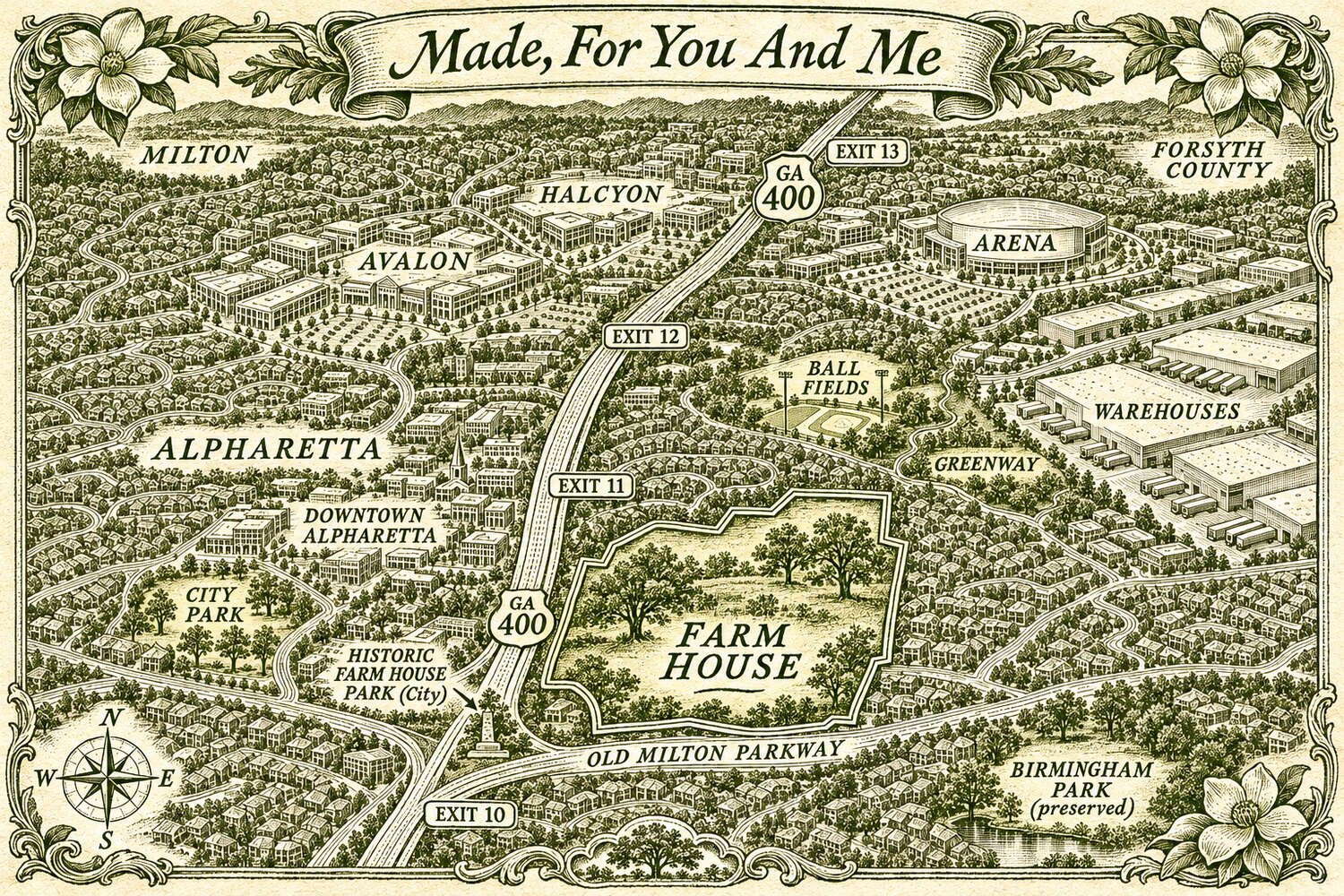
Here is the ground it would hold, in the middle of everything already built. Drag the map to look around, and zoom in: the subdivisions, the shopping, the arena and the industrial parks on every side, and the one green parcel still open.

An engraved bird's-eye map of the Georgia 400 corridor near Alpharetta: dense subdivisions, shopping, an arena and an industrial district (labeled Warehouses) on every side, a single outlined green parcel labeled Farm House at the center, the historic City Farm House park marked near Old Milton Parkway, and a few small parks and ball fields.

Drag to explore. Pinch, or use + and −, to zoom.

Nearby

Alike, and not

Farm House is not the only open ground worth knowing in this part of Georgia. Here are three of its neighbors, and how they compare.

Old Rucker Farm

Alpharetta
Size
A small farm inside Old Rucker Park
Held by
The City of Alpharetta, run by its Community Agriculture Program and volunteers since 2018
Hours
Sunup to sundown, seven days a week, the same as Farm House
Alike
The closest cousin. Both are about learning where food comes from. Old Rucker grows in a 36-bed community garden, an orchard and an apiary, gives fresh produce each week to the North Fulton Community Charities food pantry, and is raising money to turn its farmhouse into an education center.
Different
Old Rucker is a city program on public land. Farm House stays privately held, and its ground holds woods, a pond and a barn as well as whatever is grown.

Birmingham Park

Milton
Size
A large nature preserve
Held by
The City of Milton
Alike
Open land kept from development and open to the public, with paths through the woods.
Different
Far larger, and built around nine natural-surface trails for hikers and riders. Farm House is kept close, with the barn and the table at its center.

Big Creek Greenway

Roswell, Alpharetta and Forsyth County
Size
A trail of about 26 miles, open in sections
Held by
Public, built piece by piece by the cities and the county along its route
Alike
Green ground running through the middle of all this growth, free to walk.
Different
A greenway is a path for passing through. Farm House is a place to arrive and stay awhile.
How to help

Phase One: bring out its natural beauty

The first phase is the beautification of the property: clearing what has grown over it, cutting the first pathways, opening the views, bringing the grounds and the barn back to something worth walking through. Everything after that builds the programming, the event space, the public gardens, the larder, the life the place will hold. Gifts go to the Fisher & Farmer Foundation, not to the land’s owners, and the Foundation carries the work on a model meant to last.

Farm House is a project of the Fisher & Farmer Foundation, a US 501(c)(3) (status pending). Gifts are received and held by the Foundation and put toward the beautification of the land and the public gardens it will become.